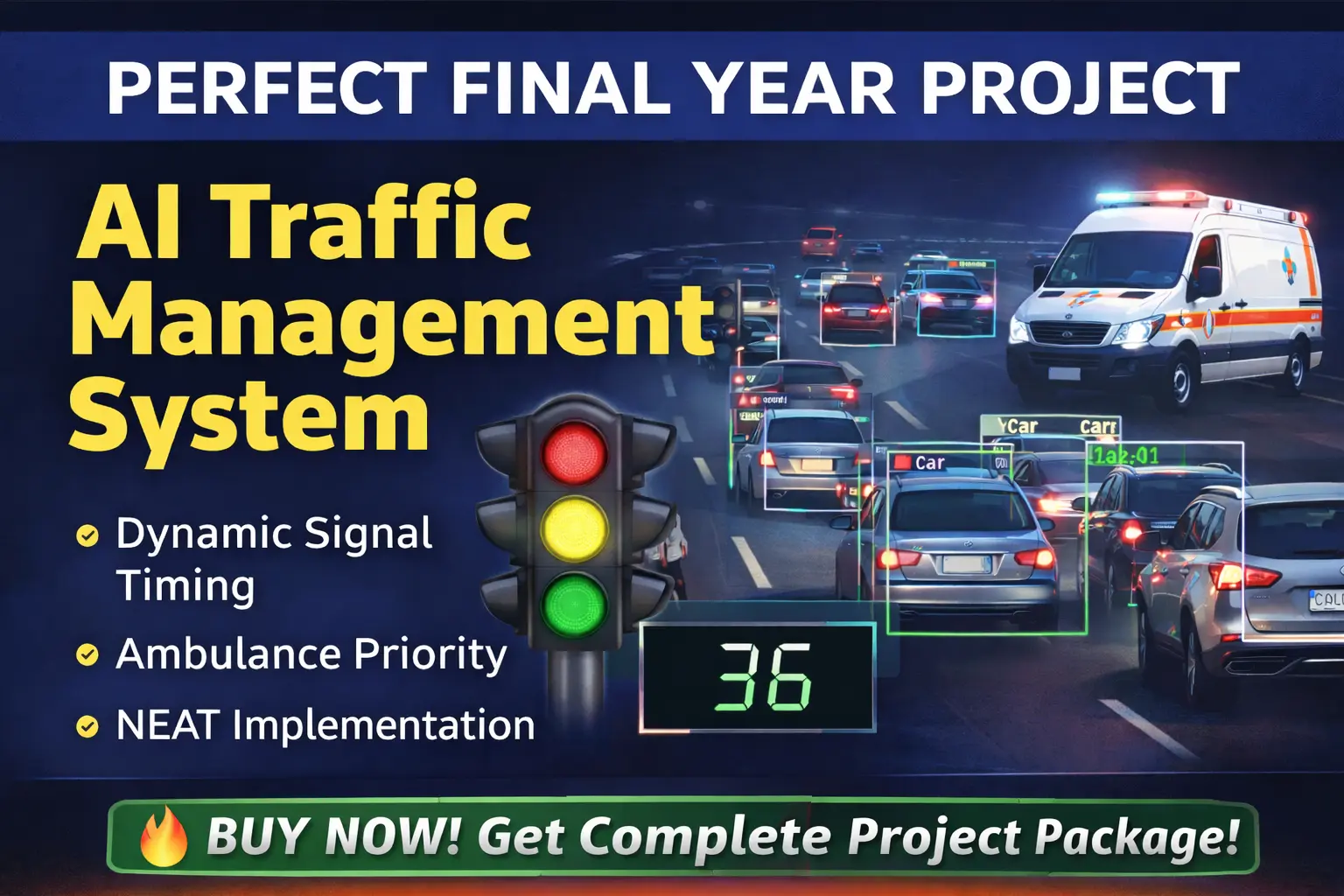
AI Traffic Management System Using Python
AI Traffic Management System Using Python and Pygame is an intelligent four-way traffic intersection simulation with dynamic signal timing and ambulance priority. It simulates cars, bikes, buses, trucks, rickshaws and ambulances, analyzes traffic density, dynamically adjusts green-light duration, creates an emergency corridor, displays real-time traffic statistics and compares static versus dynamic traffic performance.
What You Will Get
Project Overview
AI Traffic Management System Using Python and Pygame is an intelligent traffic intersection simulation designed to demonstrate adaptive traffic signal control and emergency vehicle priority. The system simulates a realistic four-way intersection where different vehicle types continuously approach and cross the junction.
Instead of relying only on fixed signal timings, the system analyzes the number of vehicles waiting at different lanes and dynamically adjusts green-light duration. It also identifies ambulances and temporarily gives their lane priority by creating an emergency corridor.
Available Features
- Four-way traffic intersection simulation
- Dynamic traffic signal timing
- AI-assisted ambulance priority
- Emergency corridor generation
- Real-time traffic statistics
- Traffic density analysis
- Multiple vehicle types
- Vehicle direction and lane management
- Vehicle speed variation
- Static traffic simulation
- Dynamic traffic simulation
- State-based traffic simulation
- Static versus dynamic performance comparison
- Traffic throughput charts
- Real-time signal state display
- Ambulance status display
- Visual Pygame simulation
- Traffic simulation graphics
Four-Way Traffic Intersection
The simulation represents a four-way road intersection where vehicles approach the junction from different directions. Vehicles are continuously generated and move according to their assigned lane, direction, speed and current traffic signal.
Multiple Vehicle Types
The simulation supports cars, bikes, buses, trucks, rickshaws and ambulances. Each vehicle type has a different movement speed to create a more realistic traffic environment.
- Ambulance: 4.5 px/frame
- Bike: 2.5 px/frame
- Car: 2.25 px/frame
- Rickshaw: 2.0 px/frame
- Bus: 1.8 px/frame
- Truck: 1.8 px/frame
Dynamic Traffic Signal Timing
The system evaluates traffic density before deciding how long a signal should remain green. When a lane has a higher number of waiting vehicles, the system can provide additional green time to improve traffic flow.
The default signal configuration uses 60 seconds for red, 5 seconds for yellow and 30 seconds for green, while the green duration can be dynamically adjusted according to traffic density.
Traffic Density Analysis
The traffic-control workflow counts vehicles approaching each signal, determines the current traffic density, identifies the lane requiring additional green time and adjusts the signal duration before continuing to the next cycle.
AI Ambulance Priority
Ambulance priority is one of the main intelligent features of the system. When an ambulance enters the detection zone, the system identifies its direction and gives priority to the corresponding lane.
A short yellow transition can be applied when required, followed by a green signal for the ambulance lane. Once the ambulance clears the intersection, normal traffic signal control resumes.
Emergency Corridor
When ambulance priority is activated, the simulation displays an emergency corridor indicator. Other traffic signals are temporarily controlled so the emergency vehicle can cross the intersection without unnecessary waiting.
Real-Time Traffic Statistics
The simulation displays important information while running, including simulation time, vehicle count, current traffic signal, signal state, ambulance status, traffic movement and emergency corridor status.
Static Traffic Simulation
The static simulation uses predefined signal timings regardless of the number of vehicles waiting at each road. It provides a baseline for comparing traditional fixed-time traffic control with the adaptive approach.
Dynamic Traffic Simulation
The dynamic simulation uses traffic density to influence signal timing. Roads with higher traffic can receive additional green time, demonstrating how adaptive signal management can reduce unnecessary waiting.
State-Based Traffic Simulation
The project also includes a state-based simulation that demonstrates traffic signal management through defined signal states and transitions.
Performance Comparison
A dedicated chart module compares static and dynamic traffic-control approaches based on traffic throughput across simulation runs. The generated visualization helps demonstrate the difference between fixed signal timing and adaptive signal control.
Project Variants
- simulation_realtime.py: Main real-time AI ambulance-priority simulation
- simulation.py: Basic static-timing traffic simulation
- simulation Dy.py: Dynamic green-time traffic simulation
- simulation state.py: State-based traffic signal simulation
Traffic Simulation Workflow
- Vehicle Generation
- Vehicle Movement
- Traffic Density Analysis
- Signal Control
- Dynamic Green-Time Adjustment
- Ambulance Detection
- Emergency Priority
- Ambulance Crossing
- Normal Signal Control
- Performance Analysis
Graphics and Visualization
The project contains graphical resources for different vehicle directions and traffic signals. Vehicle graphics are organized into directional folders while traffic signal graphics are stored separately. The intersection image is used as the simulation environment.
Performance Chart
The Charts directory contains a chart-generation module that compares static and dynamic traffic performance. The generated chart focuses on traffic throughput across simulation runs.
Technology Stack
- Python
- Pygame 2.x
- Artificial Intelligence Concepts
- Traffic Simulation Logic
- Real-Time Visualization
- Python Graphics
Software and Tools Required
- Python 3.x
- Python 3.10 recommended
- Pygame 2.x
- Visual Studio Code
- Modern Windows or compatible desktop environment
Future Enhancements
- CCTV camera integration
- Real-time vehicle detection using YOLO
- Computer vision-based vehicle counting
- Automatic traffic-density calculation from video
- GPS-based ambulance tracking
- Multiple emergency vehicle support
- Machine-learning-based signal prediction
- Real-time traffic monitoring dashboard
- Cloud-based traffic analytics
- Historical traffic reports
- IoT traffic-signal integration
More Details and Full Documentation
View AI Traffic Management System Using Python and Pygame Details
Project Modules
2. Vehicle Generation Module
3. Vehicle Movement Module
4. Vehicle Direction and Lane Module
5. Traffic Density Analysis Module
6. Traffic Signal Control Module
7. Dynamic Green-Time Module
8. Static Signal Simulation Module
9. Dynamic Signal Simulation Module
10. State-Based Signal Simulation Module
11. Ambulance Detection Module
12. Ambulance Priority Module
13. Emergency Corridor Module
14. Emergency Signal Override Module
15. Real-Time Traffic Statistics Module
16. Vehicle Speed Management Module
17. Traffic Throughput Analysis Module
18. Static vs Dynamic Comparison Module
19. Performance Chart Module
20. Pygame Visualization Module
21. Vehicle Graphics Module
22. Traffic Signal Graphics Module
23. Intersection Simulation Module
24. Simulation Configuration Module
Installation Guide
1. Install Python 3.10 and Visual Studio Code.
2. Extract the project ZIP file.
3. Open the project folder in Visual Studio Code.
4. Open the VS Code terminal.
5. Create a virtual environment using: py -3.10 -m venv .venv
6. Activate the virtual environment on Windows using: .venv\Scripts\activate
7. Upgrade pip, setuptools and wheel using: python -m pip install --upgrade pip setuptools wheel
8. Install Pygame using: python -m pip install pygame==2.6.1
9. Verify Pygame using: python -c "import pygame; print(pygame.version.ver)"
10. Make sure the images directory and required graphics files are present.
11. Run the main real-time simulation using: python simulation_realtime.py
12. Run the basic static simulation using: python simulation.py
13. Run the dynamic signal simulation using: python "simulation Dy.py"
14. Run the state-based simulation using: python "simulation state.py"
15. Open the Charts directory using: cd Charts
16. Generate the static versus dynamic performance chart using: python chart.py
FAQ for this project coming soon.
No reviews yet. Be the first to review!
Write a Review
Related Projects
 33% OFF
Featured
33% OFF
Featured
 38% OFF
Featured
38% OFF
Featured
 20% OFF
Hot
20% OFF
Hot
 25% OFF
Featured
25% OFF
Featured