Demo Video
AI-Based Traffic Management System Using Python, YOLOv3 and OpenCV
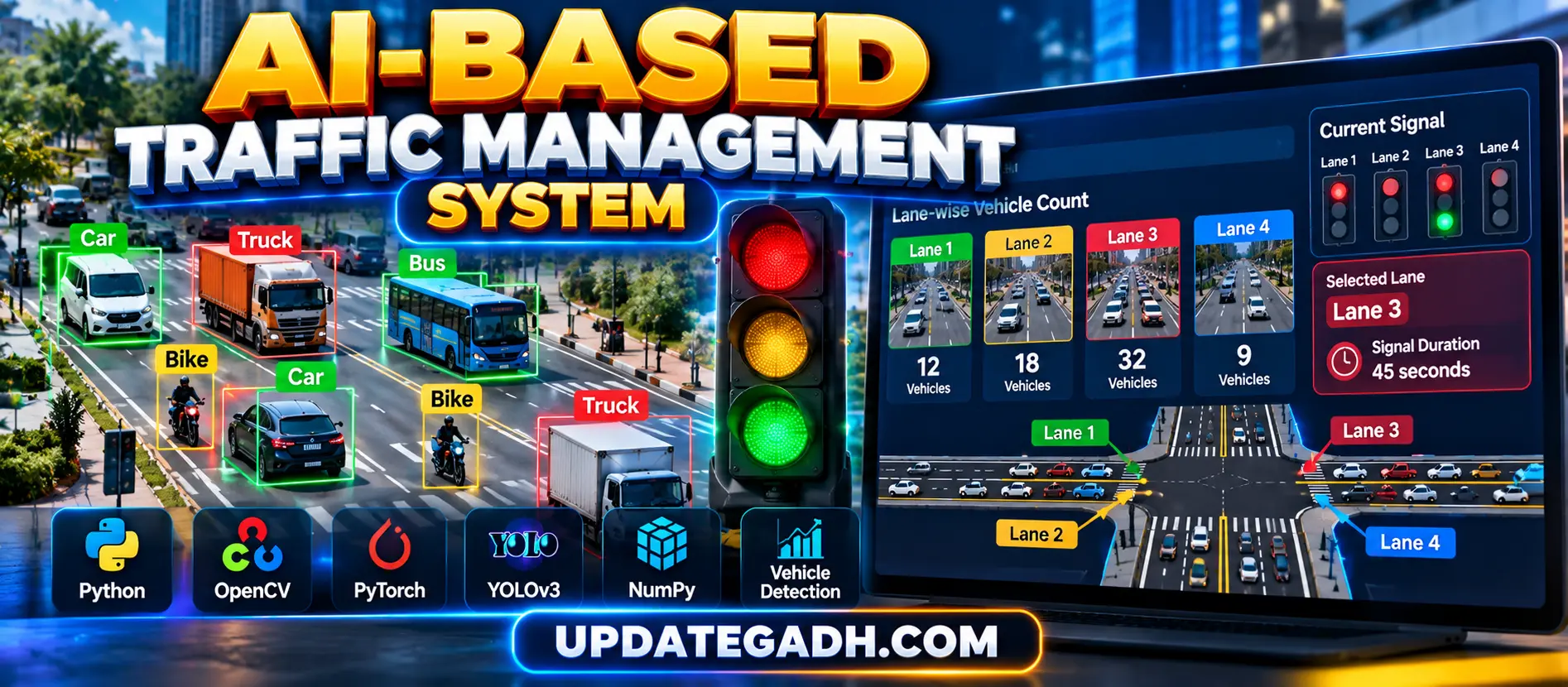
AI-Based Traffic Management System is a Python project that uses YOLOv3 and OpenCV to detect vehicles, count traffic lane-wise, analyze real-time traffic density, and dynamically adjust traffic signal timing for improved traffic flow.
What You Will Get
Project Overview
The AI-Based Traffic Management System is a Python-based computer vision project designed to make traffic signal control more intelligent and adaptive. The system uses a pre-trained YOLOv3 model to detect vehicles from traffic video or live camera feeds and OpenCV for real-time video processing.
Instead of depending on fixed traffic signal timers, the system analyzes the number of vehicles present in different lanes and dynamically adjusts green-light duration according to traffic density. Lanes with higher vehicle density can receive longer green signals, helping improve traffic flow and reduce unnecessary waiting at intersections.
Available Features
YOLOv3 Vehicle Detection
The system uses a pre-trained YOLOv3 object detection model to identify vehicles such as cars, bikes, trucks, and buses from video frames.
Lane-Wise Vehicle Counting
Traffic video or camera input is divided into different lanes, allowing the system to count vehicles separately for each traffic direction.
Dynamic Signal Timing
The traffic signal duration is adjusted according to the detected vehicle density. Higher-traffic lanes receive longer green-light durations, while lanes with lower traffic receive shorter durations.
Real-Time Video Processing
OpenCV processes traffic videos or live camera feeds in real time so the system can respond to changing traffic conditions.
Traffic Density Analysis
The detected vehicle count is used to understand the current traffic condition of individual lanes and support adaptive signal decisions.
Scalable Traffic Design
The project is designed so that the approach can be adapted for multi-lane and multi-direction intersections, making it suitable for different traffic environments.
Intelligent Traffic Decision Making
The main intelligence of the system comes from continuously analyzing vehicle flow instead of relying only on predefined fixed timers. When one lane has significantly more vehicles than another, the system can provide that lane with a longer green-light duration.
This adaptive approach is intended to improve traffic movement and reduce unnecessary vehicle waiting at intersections. By reducing idle time at red lights, the system can also contribute to lower fuel consumption and reduced vehicle emissions.
Technology Stack
- Programming Language: Python 3.x
- Object Detection: YOLOv3
- YOLO Architecture: Darknet-based model
- Image Processing: OpenCV
- Numerical Processing: NumPy
- Pre-trained Model: YOLO weights
- Custom Training: TensorFlow/Keras if custom model training is performed
Practical Applications
- Smart city traffic management
- Real-time adaptive traffic signals
- Traffic density monitoring
- Emergency traffic management concepts
- Urban traffic pattern analysis
- Traffic surveillance integration
Future Enhancement Possibilities
The project can be further extended with GPS or mapping APIs, newer YOLO models such as YOLOv5 or YOLOv8, custom regional vehicle datasets, a web-based traffic control interface, and physical traffic-light integration using platforms such as Arduino or Raspberry Pi.
Watch Project Demo
Watch AI-Based Traffic Management System Demo
More Details and Full Documentation
Project Modules
2. YOLOv3 Object Detection Module
3. Traffic Video Processing Module
4. Live Camera Processing Module
5. Lane Detection and Classification Module
6. Lane-Wise Vehicle Counting Module
7. Traffic Density Analysis Module
8. Dynamic Signal Timing Module
9. Adaptive Traffic Decision Module
10. Real-Time Monitoring Module
11. Scalable Intersection Management Module
Installation Guide
1. Install Python 3.x on your Windows system.
2. Install Visual Studio Code and open the AI-Based Traffic Management System project folder.
3. Create a virtual environment using: python -m venv venv
4. Activate the virtual environment using: venv\Scripts\activate
5. Install the required Python packages according to the project requirements.
6. Make sure the YOLOv3 configuration file, pre-trained weights and required class files are available in their expected project locations.
7. Connect a supported traffic video file or live camera source for vehicle detection.
8. Configure the traffic lanes according to the input video or camera setup.
9. Run the project's Python file responsible for traffic detection and signal management.
10. Allow the system to process the video or live camera feed.
11. The system detects vehicles using YOLOv3 and processes the frames through OpenCV.
12. Vehicle counts are calculated for individual lanes.
13. The traffic density information is used to determine adaptive signal timing.
14. Verify the detected vehicles, lane counts and dynamic traffic signal behavior from the project output.
FAQ for this project coming soon.
No reviews yet. Be the first to review!
Write a Review
Related Projects
 44% OFF
Featured
44% OFF
Featured
 13% OFF
Featured
13% OFF
Featured
 47% OFF
Hot
47% OFF
Hot
 23% OFF
Featured
23% OFF
Featured