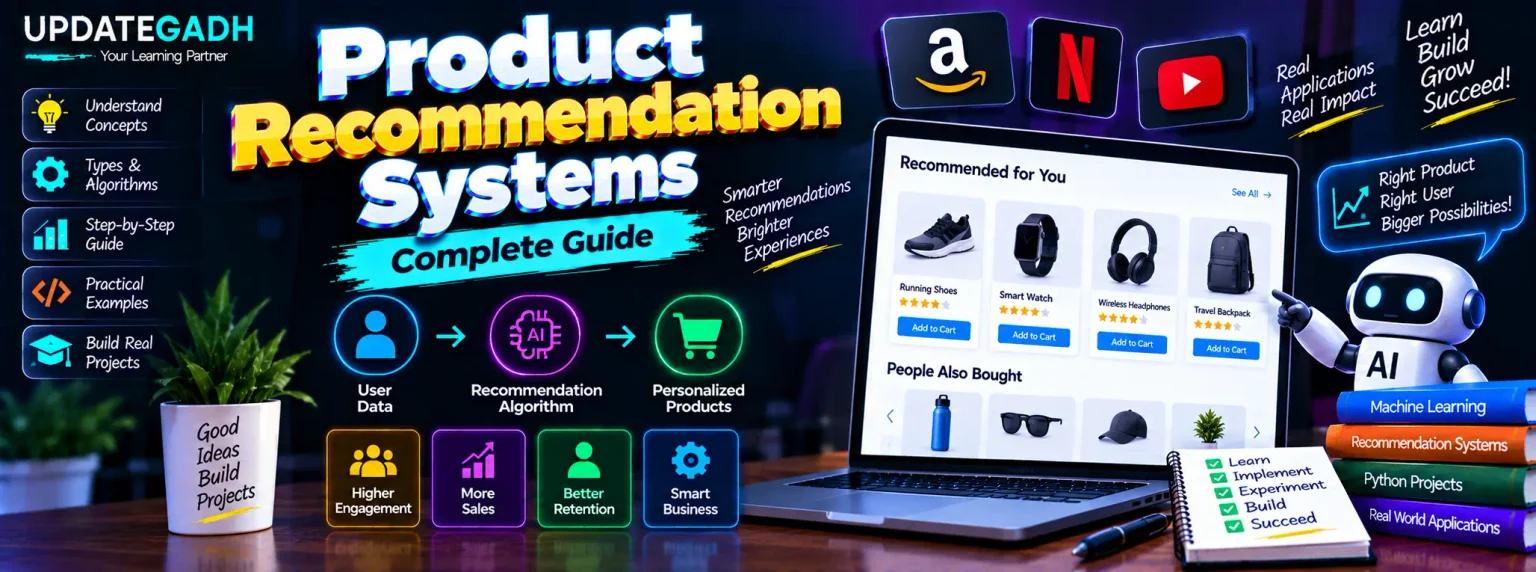
Product Recommendation Systems
Product Recommendation Systems use user activity, product information, ratings, and user-item interactions to generate personalized product suggestions. The project covers collaborative filtering, content-based filtering, hybrid recommendation systems, recommendation workflows, and commonly used machine learning algorithms.
What You Will Get
Product Recommendation Systems
Product Recommendation Systems are intelligent systems designed to analyze user and product information and generate relevant product suggestions. Instead of presenting identical products to every visitor, recommendation systems can use user preferences, product characteristics, ratings, and previous interactions to provide more personalized recommendations.
The project covers the fundamental concepts required to understand and develop a recommendation engine. It explains user-to-item compatibility, similarities between users, similarities between products, recommendation approaches, model training, and recommendation evaluation.
Key Features
- User-to-item compatibility analysis
- User similarity analysis
- Item similarity analysis
- Collaborative filtering
- Content-based filtering
- Hybrid recommendation systems
- User activity analysis
- Product feature analysis
- Data collection and preprocessing workflow
- Recommendation model selection
- Model training workflow
- Recommendation evaluation
- Product suggestion generation
Collaborative Filtering
Collaborative filtering uses user-item interaction information to generate recommendations. The approach identifies patterns in how users interact with products and can use similar interaction patterns to recommend products.
For example, when customers frequently purchase two products together, the system can use this interaction pattern to recommend one product to users interested in the other.
Content-Based Filtering
Content-based filtering focuses on product characteristics. The system compares product information with items or interests that a user has previously interacted with and recommends products with similar characteristics.
Hybrid Recommendation Systems
Hybrid recommendation systems combine multiple recommendation approaches. A hybrid model can use both user interaction patterns and product characteristics when generating recommendations.
Recommendation Workflow
- Collect user and product information.
- Clean and organize the available data.
- Select a recommendation strategy.
- Train or calculate the recommendation model.
- Generate relevant product suggestions.
- Evaluate recommendation quality.
- Improve the system using evaluation results.
Popular Algorithms
- Matrix Factorization: Techniques such as SVD can work with relationships represented through user-item interaction data.
- K-Nearest Neighbors: KNN can identify similar users or products based on available data.
- Neural Collaborative Filtering: Neural networks can learn complex patterns from user-item interactions.
- Cosine Similarity: Cosine similarity can compare feature vectors and identify similarity between products.
Data Collection and Preprocessing
The recommendation process can use user activity, ratings, interactions, and product features. Raw data needs to be cleaned and organized before being supplied to a recommendation algorithm. The quality of the input data is important because recommendation models depend on patterns contained within that data.
Recommendation Evaluation
After developing a recommendation model, its results should be evaluated. Precision, recall, and F1-score are among the metrics identified for measuring recommendation performance.
Technology and Algorithms Covered
| Technology or Method | Purpose |
|---|---|
| Collaborative Filtering | Uses user-item interaction patterns |
| Content-Based Filtering | Uses product characteristics and user interests |
| Hybrid Recommendation | Combines multiple recommendation approaches |
| Matrix Factorization | Works with user-item interaction relationships |
| SVD | Matrix factorization technique |
| K-Nearest Neighbors | Identifies similar users or items |
| Neural Collaborative Filtering | Uses neural networks for recommendation patterns |
| Cosine Similarity | Measures similarity between feature vectors |
Recommendation Applications
Recommendation systems can be used to personalize digital platforms by helping users discover potentially relevant products. They can support product discovery, personalized experiences, additional product exploration, and automated product curation.
More Details and Full Documentation
For the complete Product Recommendation Systems guide, concepts, recommendation approaches, algorithms, workflow, and implementation discussion, visit the original UpdateGadh project page.
Project Modules
2. Data Preprocessing Module
3. User-to-Item Compatibility Module
4. User Similarity Module
5. Item Similarity Module
6. Collaborative Filtering Module
7. Content-Based Filtering Module
8. Hybrid Recommendation Module
9. Recommendation Model Selection Module
10. Model Training Module
11. Product Recommendation Generation Module
12. Recommendation Evaluation Module
13. Matrix Factorization Module
14. K-Nearest Neighbors Module
15. Neural Collaborative Filtering Module
16. Cosine Similarity Module
Installation Guide
1. Review the project documentation and identify the recommendation approach required for your implementation.
2. Prepare the user-item interaction data and available product information.
3. Collect required user activity, ratings, interactions, and product features.
4. Clean and organize the collected data.
5. Prepare the dataset in a format suitable for the selected recommendation approach.
6. Select collaborative filtering, content-based filtering, or a hybrid recommendation strategy.
7. Select an appropriate recommendation algorithm such as SVD, KNN, Neural Collaborative Filtering, or Cosine Similarity.
8. Train or calculate the recommendation model using the prepared data.
9. Generate product recommendations from the trained or calculated model.
10. Evaluate recommendation results using suitable metrics such as precision, recall, and F1-score.
11. Improve the recommendation approach based on the evaluation results.
FAQ for this project coming soon.
No reviews yet. Be the first to review!
Write a Review
Related Projects
 38% OFF
Hot
38% OFF
Hot
 Featured
 17% OFF
Featured
17% OFF
Featured
 25% OFF
Featured
25% OFF
Featured