 25% OFF
 Crime Rate Predictor
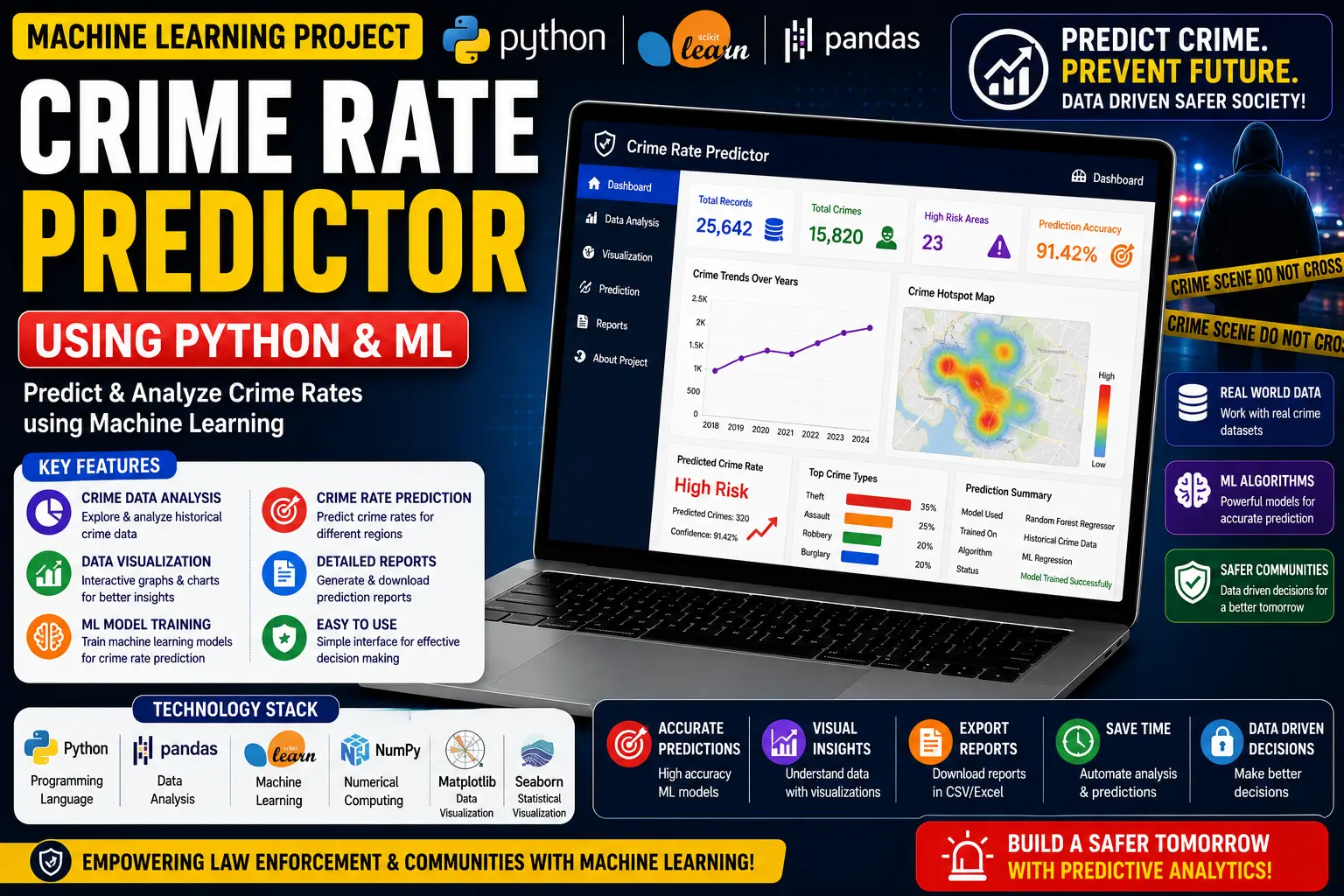
Crime Rate Predictor using Machine Learning is a Python-based application that analyzes historical NCRB crime data and predicts crime rates for 19 Indian metropolitan cities across 10 crime categories using Random Forest Regression.
Read more- Built with
- PythonMachine LearningBootstrapHTML/CSS
- You get
- Source codeDatabaseProject reportPPTSetup guide
- Delivery
- Instant download after payment
Crime Rate Predictor using Machine Learning is a data-driven application designed to analyze historical crime records and forecast future crime rates across major Indian metropolitan cities. The project uses machine learning techniques to identify crime trends, analyze historical patterns and generate predictions for different crime categories.
The system uses crime statistics from the National Crime Records Bureau (NCRB) covering the period from 2014 to 2021. It focuses on 19 metropolitan cities in India and provides predictions across 10 different crime categories. The project demonstrates how machine learning and data analysis can be applied to public safety, resource planning, risk management and crime trend analysis.
Key Features
- Crime Rate Prediction: Predicts future crime rates using historical crime records and machine learning.
- 10 Crime Categories: The system provides prediction capabilities for Murder, Kidnapping, Crime Against Women, Crime Against Children, Juvenile Crimes, Crime Against Senior Citizens, Crime Against Scheduled Castes, Crime Against Scheduled Tribes, Economic Offenses and Cybercrimes.
- 19 Metropolitan Cities: The application analyzes and predicts crime rates across 19 major metropolitan cities in India.
- Historical Crime Data Analysis: Uses NCRB crime statistics from 2014 to 2021 to identify historical patterns and trends.
- Random Forest Regression: Uses the Random Forest Regression algorithm to generate crime rate predictions based on historical data.
- City-Based Prediction: Users can select a city to generate crime rate predictions for that location.
- Crime Type Selection: Users can select the specific crime category they want to analyze and predict.
- Year-Based Prediction: Users can select the year for which they want to generate a predicted crime rate.
- Trend Analysis: Historical crime trends can be analyzed to identify increasing or decreasing patterns across different crime categories.
- Data Visualization: The project uses visualizations such as bar charts, heatmaps and line graphs to represent crime trends and patterns.
- Prediction Accuracy: The Random Forest Regression model achieves a reported accuracy of 93.20% on the testing dataset.
- User-Friendly Interface: A simple interface allows users to select the city, crime type and year before generating a prediction.
Technology Stack
| Component | Technology |
|---|---|
| Programming Language | Python |
| Machine Learning | Scikit-learn |
| Primary Model | Random Forest Regression |
| Data Analysis | Python Data Science Libraries |
| Visualization | Bar Charts, Heatmaps, Line Graphs |
| Web Interface | Flask or Streamlit |
| Dataset | NCRB Crime Records |
System Requirements
- Python environment
- Scikit-learn
- Required Python data analysis libraries
- Flask or Streamlit for the web interface
- Modern web browser such as Chrome, Firefox or Edge
- Crime dataset used by the project
How It Works
The Crime Rate Predictor follows a standard machine learning workflow. Historical crime records collected from the NCRB are first structured and cleaned. Missing values are handled and irrelevant columns are removed before the data is used for analysis.
Exploratory Data Analysis is then performed using visualizations such as bar charts, heatmaps and line graphs to identify crime trends. Time-based features and city identifiers are extracted during the feature engineering stage to improve the prediction process.
The system uses Random Forest Regression to analyze historical crime trends and generate predictions. The main inputs are Year, City Name and Crime Type. Users select these values through the application interface and click the Predict button to generate the estimated crime rate.
The model is reported to achieve 93.20% prediction accuracy on the testing dataset. The system is designed to provide data-driven insights that can assist in law enforcement planning, government policy development, research and public awareness.
Perfect For
This project is suitable for BCA, MCA, B.Tech CS/IT students, Python learners, Machine Learning students, Data Science learners and educators who want to understand how machine learning can be applied to real-world crime data and social governance problems.
It can be used for academic submissions, final-year projects, portfolio development and learning practical concepts such as data preprocessing, exploratory data analysis, feature engineering, regression models, model evaluation and data visualization.
Machine Learning Methodology
- Data Collection & Cleaning: NCRB crime records are structured, missing values are handled and irrelevant columns are removed.
- Exploratory Data Analysis: Bar charts, heatmaps and line graphs are used to understand crime trends.
- Feature Engineering: Time-based features and city identifiers are extracted from the dataset.
- Model Training: Machine learning algorithms are applied to historical crime data, with Random Forest Regression used for the main prediction system.
- Model Evaluation: Prediction performance is evaluated using metrics including R², RMSE and MAE.
Future Enhancements
- Integration with live crime data for real-time predictions.
- Interactive heatmaps and advanced trend visualizations.
- Crime hotspot detection using geospatial mapping.
Watch Project Demo
Watch the project walkthrough and setup tutorial on our YouTube channel.
▶ Watch on YouTube – Decode It
More Details & Full Documentation
For complete project details, source code and setup information, visit the official project page.
Data Analysis Module
- NCRB crime data analysis
- Data cleaning
- Missing value handling
- Exploratory data analysis
- Crime trend analysis
- Feature engineering
Prediction Module
- Random Forest Regression
- Year-based prediction
- City-based prediction
- Crime type prediction
- Crime rate forecasting
- Model evaluation
User Module
- Select city
- Select crime type
- Select year
- Generate prediction
- View predicted crime rate
- Install Python
- Download and extract the project ZIP file
- Open the project folder in VS Code or another Python IDE
- Install the required Python packages
- Make sure the project dataset is available
- Run the application using:
python app.py
- Open the local application in your browser
- Select the city, crime type and year
- Click the Predict button to generate the crime rate prediction
Stuck while running it? Chat with us on WhatsApp for free installation help.
No reviews yet. Be the first to review this project.